Lighting
How many lumens does a desk lamp need? Lumens vs lux
A large lumen figure on a box does not tell you whether the whole notebook will be well lit. The light leaving a lamp and the light reaching a surface are different measurements.
Türkçe oku ↗
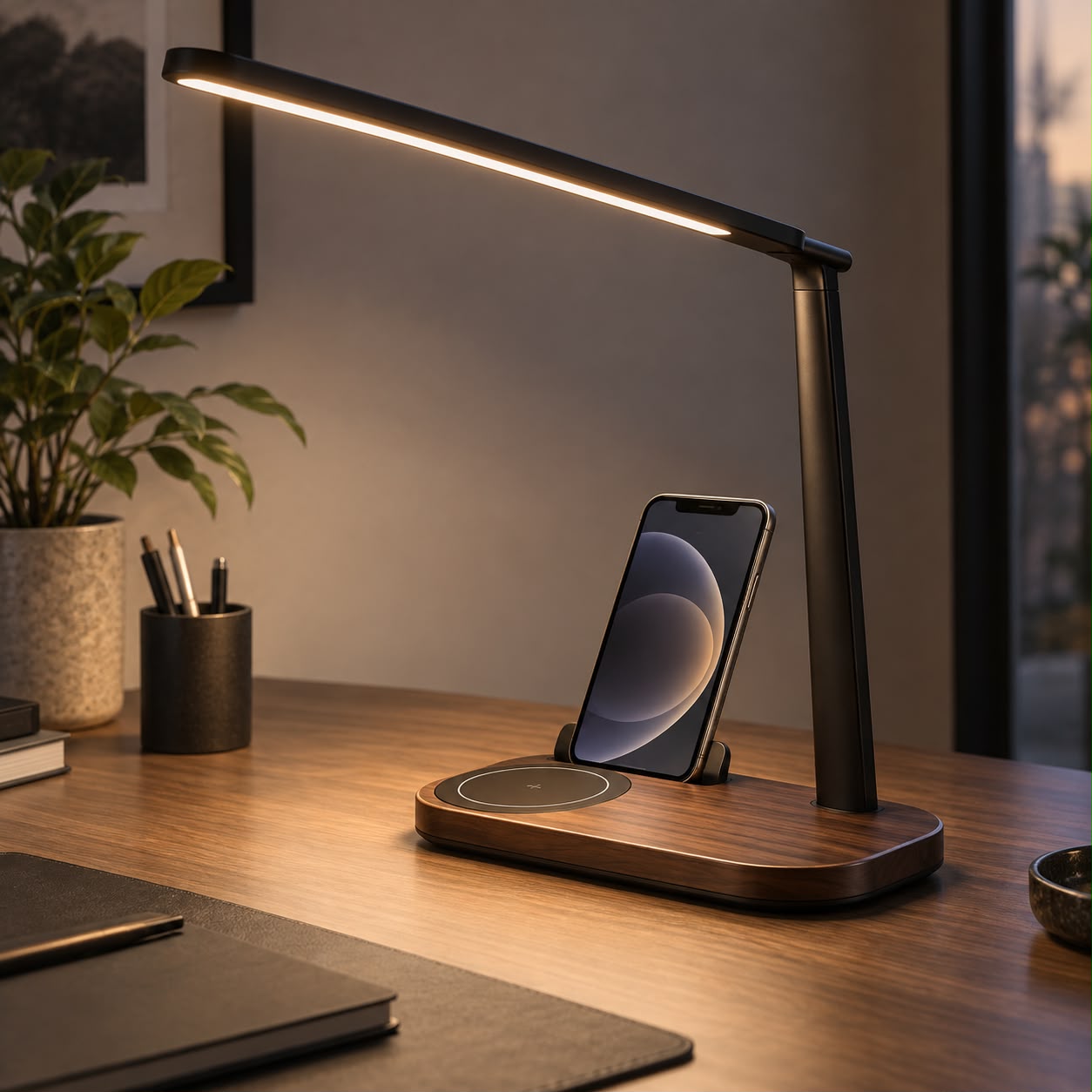
The AI-generated cover illustrates a workspace; it is not a photograph of a product for sale.
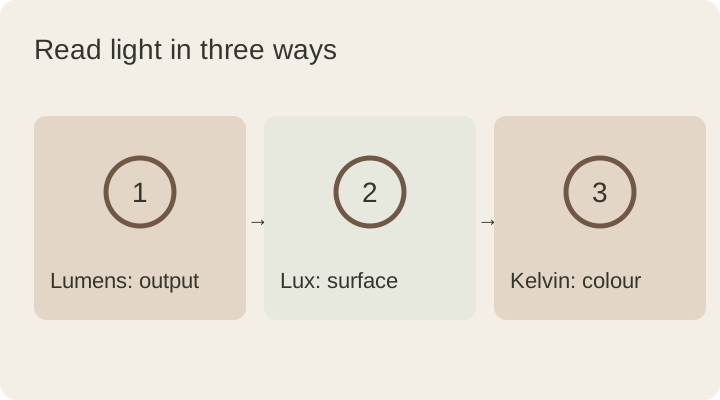
Lumens describe light output; lux describes illuminance at a surface. There is no universal lumen target for every desk because distance, beam spread and room lighting change the result.
Keep the four units separate
| Unit | Describes | Does not establish |
|---|---|---|
| Lumens (lm) | Total luminous flux | Illumination at every part of a page |
| Lux (lx) | Illuminance on a surface | Coverage without a measurement position |
| Watts (W) | Electrical power | Brightness on its own |
| Kelvin (K) | Colour temperature | Amount of light |
The appearance of the light and how it renders object colours are also different properties. The US Department of Energy’s LED overview discusses them separately. Be clear about the characteristic you are comparing rather than selecting the largest number on a label.
Why there is no universal lumen target
A narrow beam can strongly illuminate a small area, while the same output spread widely covers more surface. Moving or angling the lamp changes the light reaching a notebook. Ranking two different lamps by output alone therefore does not describe their results on your desk.
Define the task: brief handwritten notes, a large open book or a drawing area next to the computer. Ceiling lights and daylight contribute too. Adjustable output may be useful when working at different times of day, but its useful range still needs to match the task and your actual surroundings.
Interpret a numerical example carefully
By definition, one lux corresponds to one lumen per square metre. If all 400 lumens of an imaginary source were distributed evenly over one square metre, the average would be 400 lux. A real desk lamp does not necessarily send all its output onto that area or distribute it evenly. This calculation is not a product performance claim.
When a listing states “500 lux”, ask how far from the source it was measured and at which point. A peak central reading and an average over a surface are different information. Without measurement conditions, do not directly compare it with another product’s value obtained in a different setup.
Compare lamps consistently at home
- Keep the same notebook in the same place and fix the lamp distance.
- Keep other lights unchanged; compare daytime and evening separately.
- Check both edges of the notebook as well as its centre.
- Look for screen reflections and shadows from your hand.
- Try usable low and high brightness settings.
Do not assume a phone light-meter application is equivalent to a calibrated instrument. Sensors, device models and applications affect the reading. If numerical comparison matters, use an appropriate meter and consistent conditions. A phone observation is not a certification of the lamp’s performance.
Questions worth asking the seller
Request output, illuminance measurement positions, beam coverage, dimming and colour-temperature information together. Ask whether the head angle is adjustable and whether a chosen setting is retained after switching off. Such everyday details may be more useful than knowing maximum brightness alone.
Does higher wattage mean better lighting? Power consumption alone cannot show whether illumination suits your desk. Even when comparing similar technology, beam shape and placement still matter. More power is not a substitute for a useful distribution of light.
For colour choice, see warm versus cool lighting. For physical positioning and selection, continue with how to choose a desk lamp.
This guide was prepared for DESKIND with AI assistance. Refer to the linked sources and your device manufacturer’s current instructions for technical details. Adapt layout suggestions to your own space.
Have a correction or question? Contact us.